[AI 스터디] Section 5 : 전통적인 머신러닝 - 지도학습 모델 part 2
Logistic Regression (로지스틱 회귀)
로지스틱 회귀 소개
: regression이라는 이름이지만 분류 문제 → 이진 분류 문제
로지스틱 회귀 분류기
01. 방법
: 독립변수와 종속변수 간의 관계를 찾아내고 평가
- 회귀 식을 구해서 값을 예측 ⇒ 확률값을 반환
- 0.5 보다 작으면 0. 0.5 보다 크면 1로 분류
02. 특징 및 활용
(1) 구현이 간단
(2) 모든 분류 문제의 기초가 됨
(3) 로지스틱 회귀의 기본 개념이 딥러닝에 적용됨
(4) 문제점
- 분류 문제에 적합한 함수인가
- 모호한 경계 ⇒ 해결 : 시그모이드 함수
03. 시그모이드 함수 (= 로지스틱 함수)
(1) 로지스틱 회귀에 적합한 이유
- 경계가 명확히 보여짐
- 0 ~ 1 사이의 값을 가지므로 확률 값으로 해석 가능함
- 미분 가능함
(2) 공식
$$ f(z) = \frac{1}{1+e^{-z}} $$
- z : logit = $\theta X$⇒ 그래서 이름이 Logistic regression
- ⇒ logit안에 regression이 들어가있는 형태 (wx +b)
04. 모델 사용 코드
: sklearn.linear_model.LogisticRegression(solver=‘lbfgs’)
→ solver : optimization algorithm
로지스틱 회귀 실습 : 이진분류
데이터 소개
- 칼럼 : 사용자 id, 성별, 연령, 추정급여, 구매여부
- 예측 : 특정 사용자가 구매 할지 여부 → 구매: 1, 구매 않음: 0
User ID Gender Age EstimatedSalary Purchased
| 395 | 15691863 | Female | 46 | 41000 |
| 396 | 15706071 | Male | 51 | 23000 |
| 397 | 15654296 | Female | 50 | 20000 |
| 398 | 15755018 | Male | 36 | 33000 |
| 399 | 15594041 | Female | 49 | 36000 |
1. 데이터 확인 및 변수 설정
# 데이터 확인
df.head() # 처음부터 확인
df.tail() # 끝에서 확인
df['purchased'].value_counts() # 예측 레이블이 편향 되었는지 확인하기 위해
# 50 50 으로 되어있으면 좋겠지만, 2대 1 정도면 많이 편향 된게 아님

# 데이터 분류
# int로 넣어줘도 되지만 float 형태가 일반적이므로 변환
X = df.iloc[:, [2,3]].values.astype("float32") # age, estimatedSalary만 사용
y = df.iloc[:, 4].values.astype("float32") # purchased

X.shape, y.shape # 400,2 / 400,

# train, test split
X_train, X_test, y_train, y_test = train_test_split(X, y, test_size=0.2, random_state=0)
X_train.shape, X_test.shape, y_train.shape, y_test.shape # 320,2 / 80,2 / 320, / 80,
2. Feature Scaling
# age = 10단위, EstimatedSalaryy = 10000단위
# => 숫자 차이가 큰데 이런 경우, 큰 숫자가 리딩하기 떄문에 스케일링 필요
sc = StandardScaler() # 인스턴스 생성
X_train = sc.fit_transform(X_train) # fit, transform을 따로 할 수도 있음
# transform 만 해야함
# -> fit하면 별도로 데이터셋에 평균, 표준편차를 다시 계산하므로 미래의 데이터를 미리 계산하면 안됨
X_test  = sc.transform(X_test)

print(X_train.shape) # 320, 2
3. 모델
# fit
lr_clf = LogisticRegression(solver='lbfgs', random_state=0)
lr_clf.fit(X_train, y_train)
# predict : 예측된 class 반환
y_pred = lr_clf.predict(X_test)

# 평가
print("Test set의 실제 true 갯수 = ", sum(y_test)) # 22
print("모델이 예측한 true 갯수 = ", sum(y_pred)) #18
print("accuracy = {:.2f}".format(accuracy_score(y_test, y_pred))) # 0.925
print("precision = {:.2f}".format(precision_score(y_test, y_pred))) # 0.94
print("recall = {:.2f}".format(recall_score(y_test, y_pred))) # 0.77
# predict_proba : class 당 probability 반환
y_pred_proba = lr_clf.predict_proba(X_test)

print(y_pred_proba[:,1][:5]) # [0.12602436 0.17691062 0.2077208  0.10091478 0.10701443]

# predict는 0.5를 threshold로 했음을 확인할 수 있는 코드
sum((y_pred_proba[:, 1] > 0.5) == y_test)/len(y_test) # predict의 accuracy값과 동일
sum((y_pred_proba[:, 1] > 0.5) == y_test) # 몇개를 맞췄는지 개수 확인

# threshold = 0.5 -> 보통 기본적으로 이 값이 지정됨
threshold = 0.5
y_pred_proba = lr_clf.predict_proba(X_test)
y_pred_proba_1 = y_pred_proba[:, 1] > threshold
sum(y_pred_proba_1 == y_test) / len(y_test)

# threshold = 0.4
threshold = 0.4
y_pred_1 = y_pred_proba_1 > threshold
# threshold 감소시, accuracy : 감소, precision : 감소, recall : 증가
print("threshold가 {}일 때 1 로 분류된 갯수: ".format(threshold), sum(y_pred_1))
print("precision = {:.2f}".format(precision_score(y_test, y_pred_1)))
print("recall = {:.2f}".format(recall_score(y_test, y_pred_1)))
print("f1 score = ", f1_score(y_test, y_pred_1))

# threshold = 0.6
threshold = 0.6
y_pred_2 = y_pred_proba_1 > threshold
# threshold 증가시, accuracy : 감소, precision : 증가, recall : 감소
print("threshold가 {}일 때 1 로 분류된 갯수: ".format(threshold), sum(y_pred_2))
print("precision = {:.2f}".format(precision_score(y_test, y_pred_2))
print("recall = {:.2f}".format(recall_score(y_test, y_pred_2)))
print("f1 score = ", f1_score(y_test, y_pred_2))
04. 평가
# 혼동행렬
cm  = confusion_matrix(y_test, y_pred, labels=[1, 0])

ax = sns.heatmap(cm, annot=True, fmt='d')
ax.set_ylabel('true') # 가로 세로 주의
ax.set_xlabel('predicted')
ax.set_title('Confusion Matirx')

# Roc curve
y_proba = lr_classifier.predict_proba(X_test)
y_scores = y_proba[:,1] # 전체 확률에 대해 1일 확률

# _ 사용해줘야함
fpr, tpr, _ = roc_curve(y_test, y_scores) # false positive rate : fpr, true positive rate : tpr
auc = roc_auc_score(y_test, y_scores)

plt.plot(fpr, tpr, label="auc="+ "{:.2f}".format(auc))
plt.xlabel('False Positive Rate')
plt.ylabel('True Positive Rate')
plt.title('ROC Curve')
plt.legend()
Ensemble Learning (앙상블 학습)
앙상블 학습 이란 ?
: 다수의 약한 학습기를 조합 하여 더 높은 성능을 추출해냄
앙상블 학습 방법
01. Bagging (배깅) (Bootstrap Aggregating)
(1) 배깅이란? : 복원 추출을 통해 여러 모델을 결합하여 단일 모델보다 더 나은 성능을 내는 것
(2) 분류기 훈련방법 : 트레이닝 샘플의 subset을 무작위 추출 후, 분류기 훈련
(3) 효과 : 편향(모델 복잡도)이 커지지 않으면서 분산을 줄일 수 있음
→ 이유 : 랜덤 샘플링에 의한 모델 fit
(4) Bootstrap (복원 추출) : 샘플을 추출하는데, 이전에 추출된 샘플을 다시 뽑힐 수 있도록 하는 추출 방법
→ 비복원 추출 : 중복 되는게 없도록 샘플 추출
→ 효과
- variance = $\frac{𝜎 ^2}{b}$으로 감소
- Mean = 동일
(5) Bagging tree 알고리즘
- training data 에서 random sampling 하여 X_b, y_b 를 고름 (ex. 1,000 개의 data 중 100 개 sampling)
- X_b, y_b 를 이용하여 ID3 알고리즘으로 decision tree 구성
- B 개의 tree 가 만들어질 때까지 1, 2 반복
- B 개의 모든 tree 를 이용하여 classification 한 후 majority vote 로 결정
- Bias 를 유지하며 Variance 를 줄인다.
(6) 랜덤 포레스트
- 문제점 : 몇 개의 트리를 만들든 첫 번째 노드에는 같은 열이 사용될 것임 ⇒ 나무가 다 비슷할 것, 일반화 능력에 도움이 되지 않음
- 해결 방법 : Decision Tree 에 포함될 attribute 들을 random 하게 일부만 선정
➔ 모든 attribute 를 가지고 Tree 를 만들 경우 매우 강한 attribute 가 모든 tree 에 항상 포함됨 - 장점
- 더 Random 하고 독립적인 classifier 생성가능
- 다양한 다른 특성의 나무들이 생성되므로 이 결과를 voting 해서 최종을 내면 좋은 성능을 냄
- Tree-based model 이므로 white box 특징을 유지
- High prediction accuracy
- 병렬적으로 생성 가능하므로 속도가 빠름
- 각 tree 는 매우 deep 하게 생성
02. Boosting
(1) 부스팅 방법 2가지
- 잘못 분류된 데이터에 더 높은 가중치를 부여하여 다음 모델의 샘플링에 포함될 확률을 높이는 방법
- 모델 자체를 부스팅 : 다수의 약한 학습기를 훈련시켜 majority voting (→ 배깅과 동일한 방법)
(2) 대표적인 메소드 : AdaBoost, Gradient Boost (XGBoost)
(3) Gradient Boost (XGBoost)
- 방법 : weak learner를 이용한 모델 부스팅
- Weak Learner (약한 학습기) : 랜덤하게 선택하는 것 보다 약간 더 나은 성능의 모델
⇒ 의사결정나무를 사용하였음 - 기존의 weak learner 가 생성한 잔차를 감소시키는 추가 tree 를 감소 효과가 없을 때까지 생성
- 이전 의사결정 나무로 부터 생성된 잔차를 다음 의사결정나무에 사용되는 input의 레이블로 사용
- 첫번째 나무 : 잔차 생성 / 이후의 나무 : 얼마의 잔차가 생성될지, 예측하는 훈련
⇒ 나무들의 output을 전부 더하면 y값이 얼마인지 알 수 있음
⇒ 나무가 생성될 수록 잔차 = 0 이 됨
- Weak Learner (약한 학습기) : 랜덤하게 선택하는 것 보다 약간 더 나은 성능의 모델
- Optimization 방법 : 경사하강법에 의한 손실 함수 optimize
(5) AdaBoost (Adaptive Boosting)
- 방법 : 데이터를 부스팅하는 방법
- 첫번째 생성되는 모델 ⇒ Stump ( depth가 두 개인 부정확한 이진 분류기 )
이전 stump 에서 잘 못 분류한 데이터의 가중치를 높여, 다음 sampling 에 포함되도록함
⇒ 모델로 부터 분류된 값들을 combined해서 최종 분류 결과를 냄
랜덤포레스트 & gradient boosting 실습
데이터 소개
- 칼럼 : 사용자 id, 성별, 연령, 추정급여, 구매여부
- 예측 : 특정 사용자가 구매 할지 여부 → 구매: 1, 구매 않음: 0
| User ID | Gender | Age | EstimatedSalary |
| 15706071 | Male | 51 | 23000 |
| 15654296 | Female | 50 | 20000 |
| 15755018 | Male | 36 | 33000 |
| 15594041 | Female | 49 | 36000 |
1. 변수 설정
X = df.iloc[:, [2,3]].values.astype("float32") # age, estimatedSalary
y = df.iloc[:, 4].values.astype("float32") # purchased

# train, test split
X_train, X_test, y_train, y_test = train_test_split(X, y, test_size=0.2, random_state=0)
X_train.shape, X_test.shape, y_train.shape, y_test.shape
2. feature scaling
# Feature Scaling
sc = StandardScaler()
X_train = sc.fit_transform(X_train)
X_test  = sc.transform(X_test)
3. Random Forest model
# fit
# 10개 나무 만들어서 하는 배깅
rf = RandomForestClassifier(n_estimators=10, random_state=0)
rf.fit(X_train, y_train)

# predict
y_pred = rf.predict(X_test)

# accuracy
accuracy_score(y_test,y_pred)
print("accuracy = {:.2f}".format(sum(y_pred == y_test) / len(y_test)))

# confusion matrix
print("confution matrix\\n",
      confusion_matrix(y_test, y_pred, labels=[1, 0]))
# f1 score
print("f1 score\\n", f1_score(y_test, y_pred, labels=[1, 0]))
5. Gradient Boosting Classifier
- min_samples_split : node 분리에 필요한 최소 sample 수 => overfitting 방지
- max_depth : tree 깊이 조절 => overfitting 방지
- learning_rate : 각 tree 의 기여도 조정, n_estimators 와 trade-off
- n_estimators : number of sequential trees
from sklearn.ensemble import GradientBoostingClassifier
# 모델
# 잔차를 계속 이어서, 앞의 트리가 만든 오류를 뒤에 트리가 오류를 예측하는 것이기 때문에 나무를 많이 생성해야함 -> 500
# 부정확한 나무들이 계속 이어져서 앞의 잔차를 예측하는 모델이므로 max_depth를 작게
gb = GradientBoostingClassifier(learning_rate=0.1, n_estimators=500, max_depth=5)

# fit
gb.fit(X_train, y_train)

# predict
y_pred = gb.predict(X_test)

# 결과 확인
print("Test set true counts = ", sum(y_test))
print("predicted true counts = ", sum(y_pred))
print("accuracy = {:.2f}".format(
            sum(y_pred == y_test) / len(y_test)))

# 혼동행렬
print("confution matrix\\n",
      confusion_matrix(y_test, y_pred, labels=[1, 0]))

# f1 score
print("f1 score\\n", f1_score(y_test, y_pred, labels=[1, 0]))
6. 훈련 결과 시각화
시각화를 위한 가상의 데이터 생성
# 가상의 데이터 생성 : 전체 레코드에 대해서 최소 최대 사용
x1_min, x1_max = X_test[:, 0].min() - 1, X_test[:, 0].max() + 1
x2_min, x2_max = X_test[:, 1].min() - 1, X_test[:, 1].max() + 1

# x1, x2가 서로 교차되는 점 마다 데이터를 생성해줌 -> meshgrid
X1, X2 = np.meshgrid(np.arange(x1_min, x1_max, 0.1),
                     np.arange(x2_min, x2_max, 0.1))
X1.shape, X2.shape # (60, 61) / (60, 61)

# X1, X2를 1차원으로 펼쳐줘서 각 축의 값을 만듬
XX = np.column_stack([X1.ravel(), X2.ravel()])
XX.shape # (3360,2)만큼의 가상데이터가 생성됨
가상의 데이터로 모델 예측
# random forest로 예측한 값
Y_rf = np.array(rf.predict(XX))
# gradient boost로 예측한 값
Y_gb = np.array(gb.predict(XX))
시각화
# 두가지 색 만듬
from matplotlib.colors import ListedColormap
cmap_light = ListedColormap(['#FFAAAA', '#AAFFAA']) # 연한 값
cmap_bold = ListedColormap(['#FF0000', '#00FF00'])  # 진한 값

# 시각화
fig, (ax1, ax2) = plt.subplots(1, 2, figsize=(10, 4), sharey=True)

# Random Forest 시각화
# 결정경계 생성
ax1.pcolormesh(X1, X2, Y_rf.reshape(X1.shape),cmap=cmap_light, shading='auto')
# y_test가 0일때, 1일때 나눠서 데이터를 점으로 표현 -> 색을 다르게 그리도록 함
for i in range(2):
    ax1.scatter(X_test[y_test == i, 0], X_test[y_test == i, 1], s=20, color=cmap_bold(i), label=i, edgecolor='k')
ax1.set_title('Random Forest')
ax1.set_xlabel('Age')
ax1.set_ylabel('Estimated Salary')
ax1.legend()

# Gradient Boosting 시각화
ax2.pcolormesh(X1, X2, Y_gb.reshape(X1.shape), cmap=cmap_light, shading='auto')
for i in range(2):
    ax2.scatter(X_test[y_test == i, 0], X_test[y_test == i, 1], s=20, color=cmap_bold(i), label=i, edgecolor='k')
ax2.set_title('Gradient Boosting')
ax2.set_xlabel('Age')
ax2.legend()
plt.tight_layout()

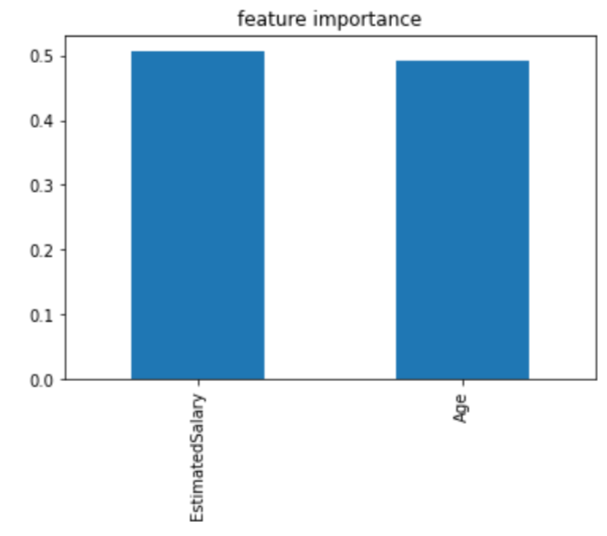
# Age, EstimatedSalary 의 중요도
feature_imp = pd.Series(gb.feature_importances_,
            ['Age', 'EstimatedSalary']).sort_values(ascending=False)
feature_imp.plot(kind='bar', title='feature importance')ㄴ
Feature Engineering
좋은 피처의 조건
- Target 과의 높은 관련성
- prediction 시점에 알 수 있음
- 월 중에는 알 수 없고, 월말에만 알 수 있는 데이터들 → ex. sales data 는 익월에 집계
- 아직 발생하지도 않은 데이터로 훈련하게 되는 상황
- numeric
- 충분한 데이터 수
- 인간 전문가의 도메인 지식 활용 가능 : 관점의 차이가 다를 수 있음
- Example ) 교통 정보 데이터 : 발생 시점
- → 요일별로 나누는게 좋을 거야! 라는 지식이 있을 경우, 예측에 도움이 될 수도 있음
머신러닝을 위한 피처 엔지니어링
- 결측치 처리
- Data formatting : 데이터 통일
- 편향 처리
- Normalization (= feature scaling) : scale이 다를 때, 비슷한 스케일로 해주는게 예측이 더 잘됨
- Binning : 연속된 숫자를 어떠한 기준으로 그룹핑 하기 위해 범위를 정해주는 것
- Categorical 변수 → 수치형으로
- ordinal category (순서/크기가 있는 feature)
- 숫자로 크기(순서) 표시
- ex) L > M > S → 3, 2, 1
- nominal category (순서/크기가 없는 feature)
- 이런 경우가 훨씬 많음
- 방법 : one-hot encoding
- ordinal category (순서/크기가 있는 feature)
Feature engineering & 랜덤포레스트 실습
사용데이터 : 타이타닉 데이터 → 타이타닉호의 생존 여부 데이터
01. 데이터 확인
# 필요없는 칼럼 drop
df.drop(['PassengerId', 'Name', 'Cabin', 'Ticket'], axis=1, inplace=True)

# 데이터 확인
df_titanic.info()
df_titanic.isnull().sum()
df_titanic.describe()
02. Feature Analysis
→ feature 간의 correlation check / Survived 와 각 Feature 간 상관관계 파악
# 각 피처들간의 관계가 얼마냐
# 음수 : 역의 상관관계, 0 : 거의 관계 없음, 양수 : 양의 상관관계
# cov 라는 공분산을 -1, 1 사이로 정규화 시킨 것
df_titanic.corr(numeric_only=True)

# 상관관계 시각화
g = sns.heatmap(df_titanic.corr(numeric_only=True), annot=True, cmap="coolwarm")

03. 결측치 처리
# Age -> median으 처리 : 없애기엔 너무 많기 때문
df_titanic['Age'].fillna(df_titanic['Age'].median(), inplace=True)

# Embarked -> 얼마 없어서 삭제
df_titanic.dropna(inplace=True)
04. 편향 확인
# 히스토그램을 이용해 분포를 확인해 편향 확인
df_titanic.hist(bins=30, figsize=(8, 8));
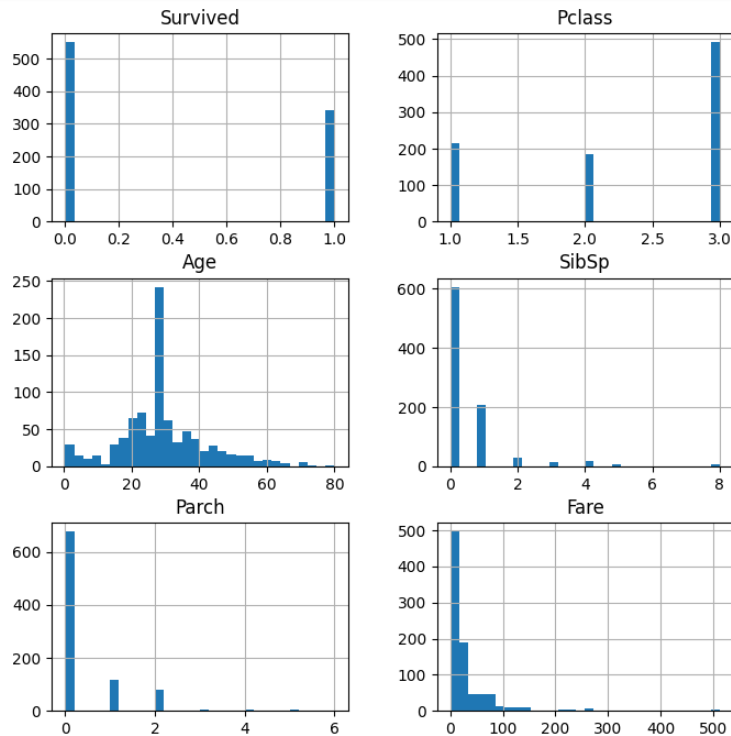
⇒ 결과 : Fare가 연속된 숫자값인데 심하게 치우침 ⇒ log값으로 바꿈
(log로 하는 이유 : 가운데 쪽으로 숫자가 몰리게 해줌 / 작은 값은 커지게, 큰값은 작게 해주는데 대소관계는 바뀌지 않음)
05. 편향 처리
# 로그로 바꿔
df_titanic['Fare'] = df_titanic['Fare'].map(lambda x: np.log(x) if x > 0 else 0)
# 다시 확인
df_titanic.hist(bins=30, figsize=(8, 8));
06. 카테고리 변수 → 수치형 변수
# 원핫 인코딩 : 카테고리컬인 칼럼을 자동으로 골라서 바꿔줌
df_titanic = pd.get_dummies(df_titanic)
| Survived | Pclass | Age | SibSp | Parch | Fare | Sex_female | Sex_male | Embarked_C | Embarked_Q | Embarked_S |
| 0 | 3 | 22.0 | 1 | 0 | 1.981001 | False | True | False | False | True |
| 1 | 1 | 38.0 | 1 | 0 | 4.266662 | True | False | True | False | False |
| 1 | 3 | 26.0 | 0 | 0 | 2.070022 | True | False | False | False | True |
| 1 | 1 | 35.0 | 1 | 0 | 3.972177 | True | False | False | False | True |
| 0 | 3 | 35.0 | 0 | 0 | 2.085672 | False | True | False | False | True |
07. 데이터 분할 / 스케일링
# train, test split
X_train, X_test, y_train, y_test = train_test_split(X, y, test_size=0.2, random_state=0)
X_train.shape, X_test.shape, y_train.shape, y_test.shape # 711,10 / 178,10 / 711, / 178,

# standart scaling
sc = StandardScaler()
X_train_scaled = sc.fit_transform(X_train)
X_test_scaled = sc.transform(X_test)
08. 모델링 및 평가 : 랜덤포레스트
from sklearn.ensemble import RandomForestClassifier

# 모델 생성
rf = RandomForestClassifier(n_estimators=10, criterion='entropy', random_state=0)
# fit
rf.fit(X_train_scaled, y_train)
# 예측 : predict
y_pred = rf.predict(X_test_scaled)
# 정확도
print("accuracy = {:.2f}".format(sum(y_pred == y_test) / len(y_test))) #0.85